Where to Put Acoustic Panels (and How to Hang Them)
The mirror trick for finding reflection points, room-by-room placement, the right height, and how to hang panels without damaging your walls.
Where you put acoustic panels matters more than how many you buy. A few panels in the right spots will do more than a whole wall covered in the wrong place. This guide covers where to put panels in the rooms people treat most, and how to hang them without wrecking your paint.
The one rule: treat the reflection points first
Sound travels from its source (your voice, your speakers, your TV) and bounces off the nearest hard surfaces before it reaches your ears or microphone. Those first bounces are the ones you hear most, so the spots where they happen are called first reflection points. Panels placed there have the biggest effect.
The mirror trick
- Sit where you normally sit: your desk chair, your spot on the sofa, your mixing position.
- Ask someone to slide a small mirror flat along the side wall at ear height.
- Wherever you can see the speaker, the TV or the person talking in the mirror, mark the wall. That is a reflection point.
- Repeat on the other side wall, and on the wall in front of you.
No helper? Use your phone's front camera the same way, or simply start at ear height on the side walls level with where you sit.
Where to put acoustic panels, room by room
Home office and video calls
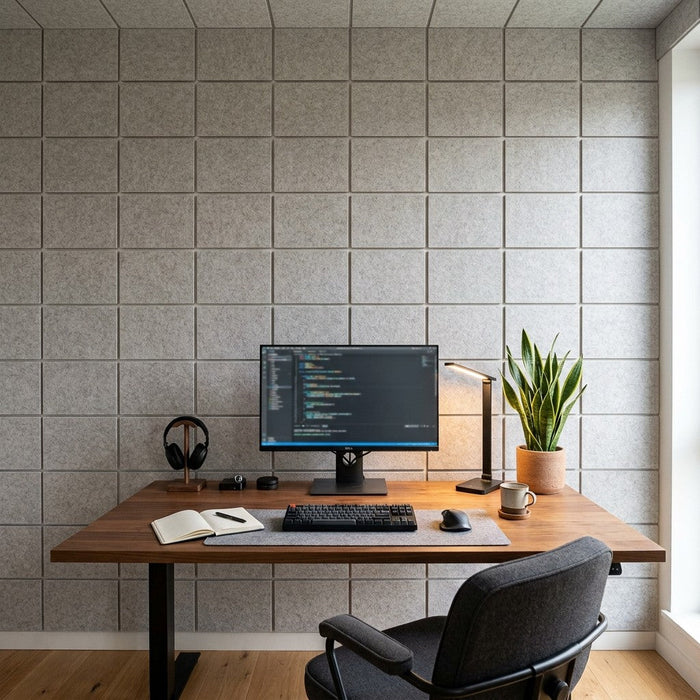
Start with the wall behind your screen, then the side walls at head height. The wall behind you is what your webcam sees, so it is a good place for a neat grid or a hexagon feature. Our home office guide goes into more detail.
Living room and TV
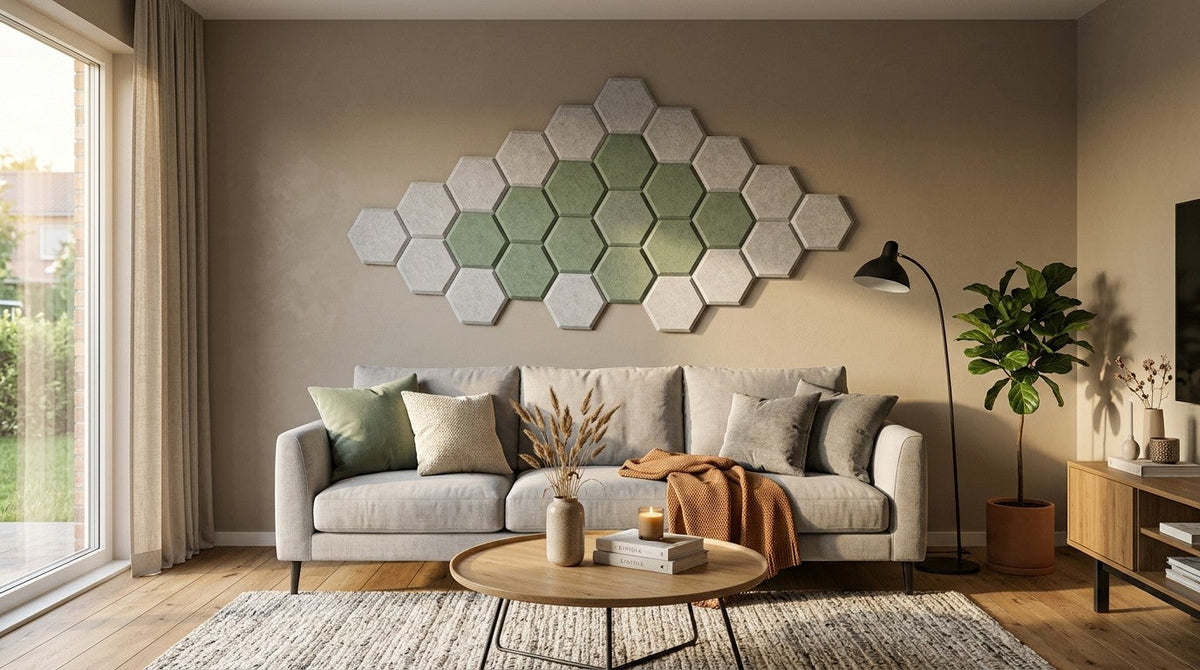
Treat the side walls between you and the TV, and the wall behind the sofa if it is close to your head. Large bare walls opposite each other are the usual cause of an echoey living room, and treating one of the pair is often enough.
Bedroom
Bedrooms usually have enough soft surfaces already. Panels above the headboard or on the largest bare wall are mostly about looks, with a gentle improvement if the room has a hard floor.
Home studio or podcast corner
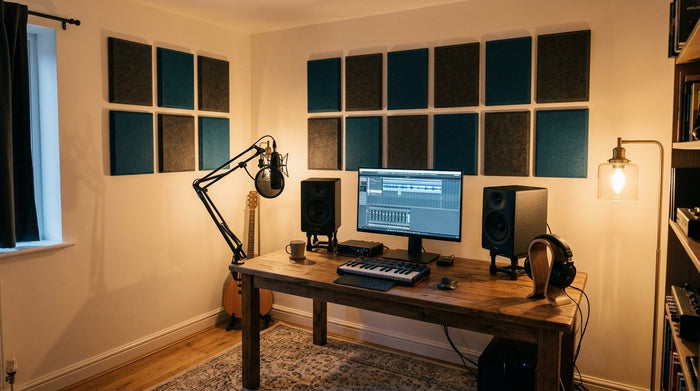
Treat the first reflection points on both side walls and the wall in front of your desk, then the wall behind you. Keep the microphone away from bare corners and walls. Low bass build-up needs thick bass traps in the corners, not thin wall panels; our room mode calculator shows which bass notes build up in your room. For a full step-by-step plan, see our home studio acoustic treatment guide.
Gaming room
Same as an office: the wall behind the screen and the side walls at head height, which also cuts down the echo your teammates hear through your headset mic.
What height to hang acoustic panels
Center the panels at the ear height of whoever uses the room: about 4 ft (1.2 m) from the floor for a seated desk or sofa, a little higher for a standing studio position. Spread a group of panels from roughly 3 ft to 6 ft so they cover seated and standing heights.
Spread them out or group them?
Several smaller groups spread across the reflection points work better than one large block on a single wall. For looks, keep the gaps between panels even: about 1/2 to 3/4 in (1 to 2 cm) for a tight grid, or larger for a staggered pattern. Hexagons can run as a honeycomb that "breaks" towards the edges, which looks deliberate even with a few packs. Try layouts first in the hexagon pattern planner.
How to hang acoustic panels
- Plan on paper or with painter's tape. Mark the outline of the group on the wall and check it is level.
- Clean the wall. Wipe off dust and grease so the adhesive grips. Freshly painted walls need the paint fully cured first; check the paint tin, but allow at least a couple of weeks.
- Start from a level line. Put the first row on a straight edge or laser line and build from there.
- Press firmly. Peel the backing and press each panel for about 30 seconds, with pressure across the whole surface, not just the middle.
How to hang acoustic panels without damaging walls
Any strong adhesive can lift paint when it is removed. If you rent, or you may want to move the panels later:
- Use removable mounting strips instead of the built-in adhesive, sized for the weight of the panel.
- Or mount the panels on a thin board and hang the board from picture hooks.
- On textured walls the built-in adhesive has less contact area, so double-sided mounting tape or strips give a better hold.
How many panels?
As a guide, treat about 15 to 20% of the wall area in a living room or bedroom, 20 to 25% in a home office, and 25 to 40% in a studio or podcast space, concentrated at the reflection points. The acoustic panel calculator works out the number of packs for your room size, and both panel styles are in our acoustic panels for walls collection.
Panels reduce echo inside a room. They do not block sound passing through walls, so they are not a fix for noisy neighbors.
More guides
All guides