
Acoustic Panels for Bedrooms and Living Rooms: Less Echo, Better Looks
Bedrooms and living rooms often echo more than people expect: hard floors, bare walls and big windows bounce sound around until voices ring and the TV sounds harsh. Acoustic panels absorb those reflections, so the room sounds calmer and voices sound clearer. They also become part of the decor, which matters in the rooms you spend the most time in. What they don't do is block noise coming through the walls; our soundproof wall panels guide explains that difference honestly.
Acoustic panels for the bedroom
Why bedrooms echo
A bedroom with a wood or tile floor, little furniture and bare walls reflects almost every sound. Signs your bedroom has an echo problem:
- Your voice sounds louder or "ringy" than it does in the rest of the house.
- Small sounds, like a door closing or a phone buzzing, seem sharp and loud.
- Video calls from the bedroom sound hollow to the other person.
A rug, curtains and soft furnishings help. Panels on the walls deal with the hard surfaces that furniture can't cover.
Headboard-wall layouts
The wall behind the bed is usually the largest uninterrupted wall in a bedroom, which makes it the natural place for panels. Three layouts that work:
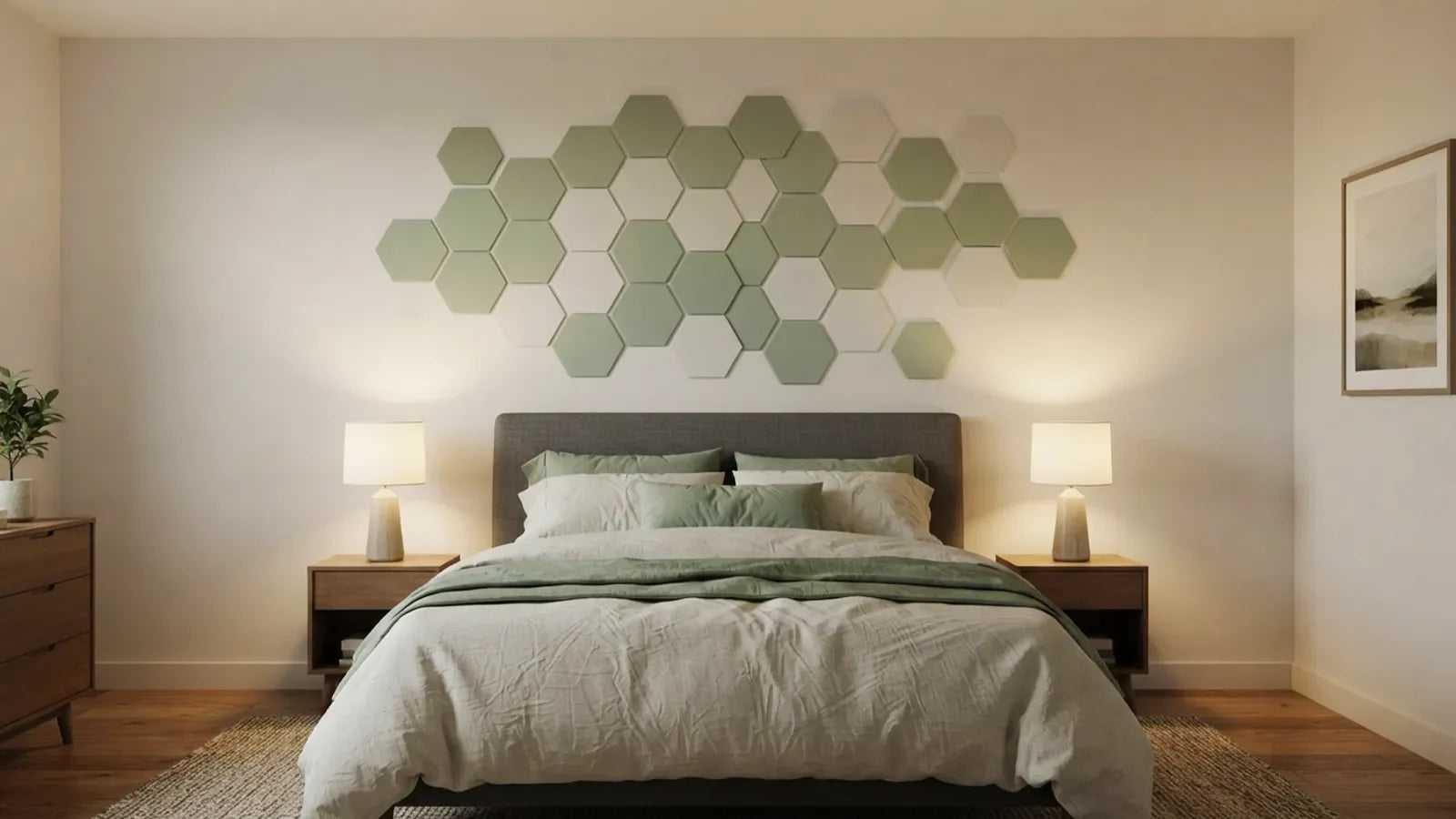
Illustration: a hexagon headboard wall.
- Headboard band: a full-width row or two of felt rectangles at headboard height, like an upholstered headboard that runs the width of the bed.
- Grid above the bed: a neat block centered over the bed, two or three panels high.
- Two columns: a vertical column of panels on each side of the bed, behind the nightstands, leaving the center of the wall free for art.
If the room still sounds lively, add a few panels to the wall opposite the bed.
Calm colors for a bedroom
Soft neutrals keep a bedroom restful: Snow White, Light Camel, Sand, Moonlight Gray or Silver Gray. For a quiet color, try Lavender, Sky Blue or Light Sky Blue. All eight come in both the felt rectangles and the hexagons. Screens show color differently, so check the photo of each color in the product gallery before you order. See decorative acoustic panels for more color and pattern ideas.
"Will panels stop noise from next door?"
No, and it's worth knowing before you buy. Noise from neighbors, a partner's TV in the next room, or traffic comes through the wall structure and through gaps around doors and windows. Panels on your side of the wall won't stop it. Sealing gaps, a door sweep and heavy curtains help most, and real wall work needs a contractor. The soundproof wall panels guide goes through the options in order of effort.
Acoustic panels for the living room
TV and conversation echo
Living rooms are usually the biggest, hardest rooms in a home: large windows, hard floors, and in many homes a high ceiling or an open plan into the kitchen. The result is a room where TV dialogue is hard to follow and conversation gets loud because everyone raises their voice over the echo.
Where to put panels in a living room
- The wall behind the sofa. Sound from the TV hits it and bounces straight back past your ears. Panels here make dialogue clearer.
- The side walls level with the seating. These catch the early reflections between the TV and where you sit.
- Around the TV. A feature wall of panels on either side of the TV treats the front of the room and frames the screen.
- Opposite a large window. Glass can't be covered, so treating the wall facing it takes some of the edge off.
Feature-wall layouts
In a living room, panels are on show, so treat them as a design element. Hexagons suit a graphic feature wall: a honeycomb block, a scatter that breaks up at the edges, or a gradient through shades of one color. Felt rectangles suit a clean grid or a two-tone checker. Plan a hexagon layout in the pattern planner, which counts the packs for you, and see decorative acoustic panels for more ideas.
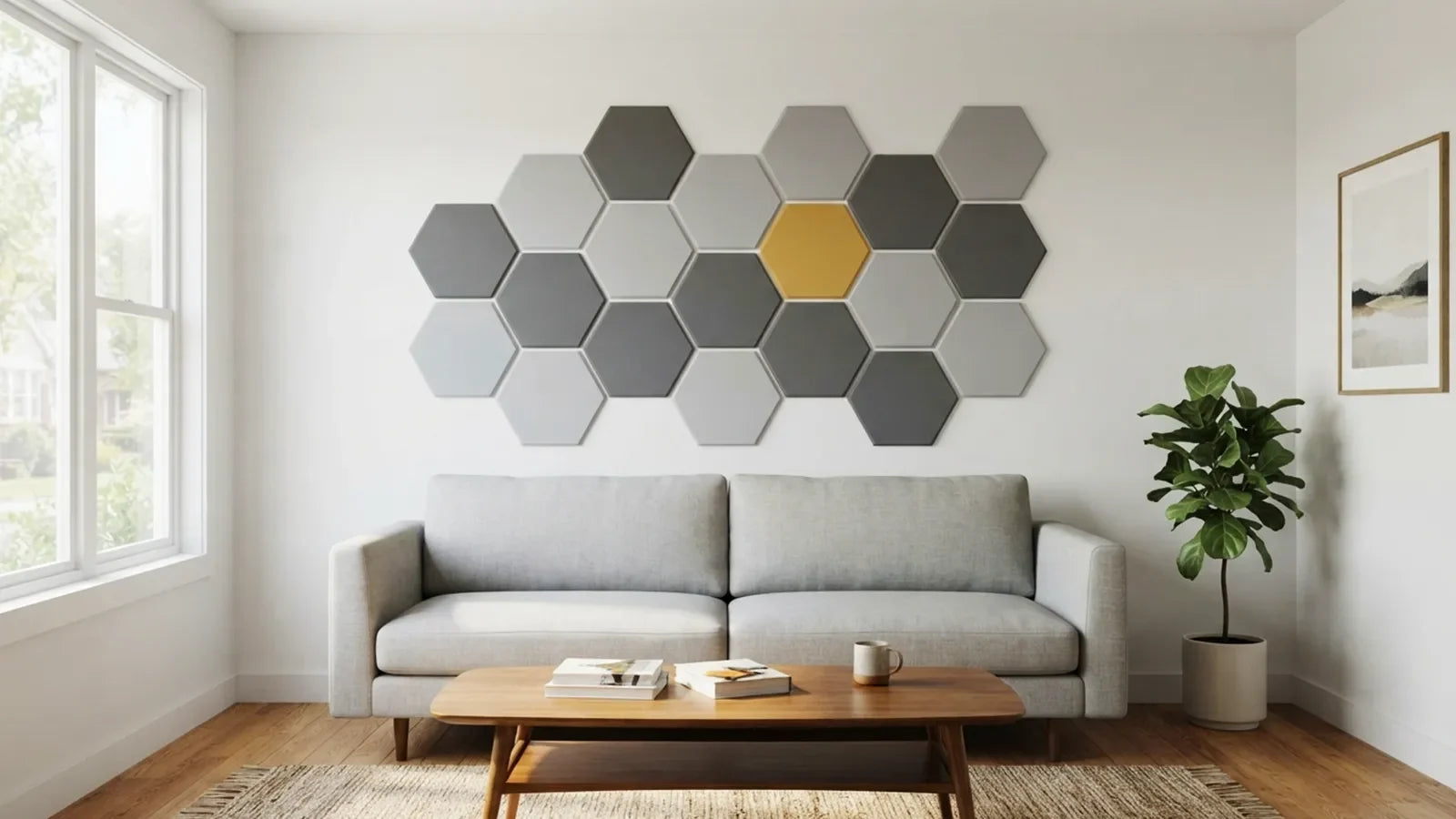
Illustration: a honeycomb feature wall above a sofa.
How many panels you need
To reduce echo across a room, a common starting point is about 20–25% of the wall area. A feature wall that is mainly decorative can use less. Each pack covers about 7.75 sq ft (felt) or 7.5 sq ft (hexagons). Living rooms are usually larger and need more, so put your own room size into the panel calculator, or measure individual walls with the wall square-footage calculator.
Renting?
Both panels have a self-adhesive backing: peel, press and hold for 30 seconds, no drilling. The adhesive can lift paint when a panel is removed, so if you rent, use removable mounting strips instead. Strips are also the better choice on textured walls. Our step-by-step guide to how to hang acoustic panels covers layout, leveling and renting.
The two packs
- Felt Acoustic Panels, 6-pack: dense polyester felt, 15.7 × 11.8 in (40 × 30 cm) each, about 7.75 sq ft per pack, 26 colors. $39.99.
- Hexagon Acoustic Panels, 12-pack: high-density acoustic board, 11.8 × 10.2 in (30 × 26 cm) each, about 7.5 sq ft per pack, 26 colors. $44.99.
Both are 0.35 in (0.9 cm) thick and ship free to the US and UK; see the shipping policy for delivery times. See all acoustic panels.
Questions people ask
Do acoustic panels help in a bedroom?
Yes, if the bedroom echoes: they absorb reflections off hard walls, so the room sounds calmer and voices don't ring. They won't block noise coming in from outside the room.
Where should acoustic panels go in a living room?
Start with the wall behind the sofa and the side walls level with the seating. Then add panels around the TV or on the wall facing a large window.
How many acoustic panels does a living room need?
It depends on the room's size and how hard its surfaces are. About 20–25% of the wall area is a common starting point for reducing echo. The panel calculator turns your room size into a number of packs.
Will acoustic panels block noise from the next room?
No. They reduce echo inside the room but don't block sound passing through walls or doors. The soundproof wall panels guide covers what does help.
Can I put acoustic panels up in a rental?
Yes, with removable mounting strips. The built-in adhesive can lift paint when a panel comes off, so strips are the safer choice when you rent.
1. Your room
We subtract 21 sq ft (1.95 m²) per door and 15 sq ft (1.39 m²) per window.
2. What you use the room for
3. Pick your panels
Your result
Free US shipping · 30-day guarantee. Want to mix colors? Add the first color here, then add more from the product page.
Where to put them
- Start at ear height, about 3 to 6 ft from the floor.
- Cover the wall your microphone or face points at, and the side walls level with where you sit.
- Spread panels in a few groups rather than one big block on one wall.